

How do you create realistic live-fire training that reflects a complex operational environment?
And how do you achieve this without spending most of the allocated training time on preparation and complicated target-system programming?
When everything happens at once
The modern battlefield is not divided into separate phases. A unit may, at the same moment, encounter infantry in the terrain, armoured vehicles on the flank and drones in the air.
That is precisely when decision-making is put to the test. It is therefore not enough simply to train soldiers to hit targets. Before a shot is fired, a unit must make a series of decisions, communicate and manoeuvre. When a high degree of realism is achieved in the way opposing forces behave, the unit’s tactical and combat skills are challenged in a completely different way.
When different types of target equipment are used together, situations arise in which both the individual shooter and the commander must detect, identify and prioritize. They must choose the right moment, the right weapon system and the right ammunition in order to win the fight.
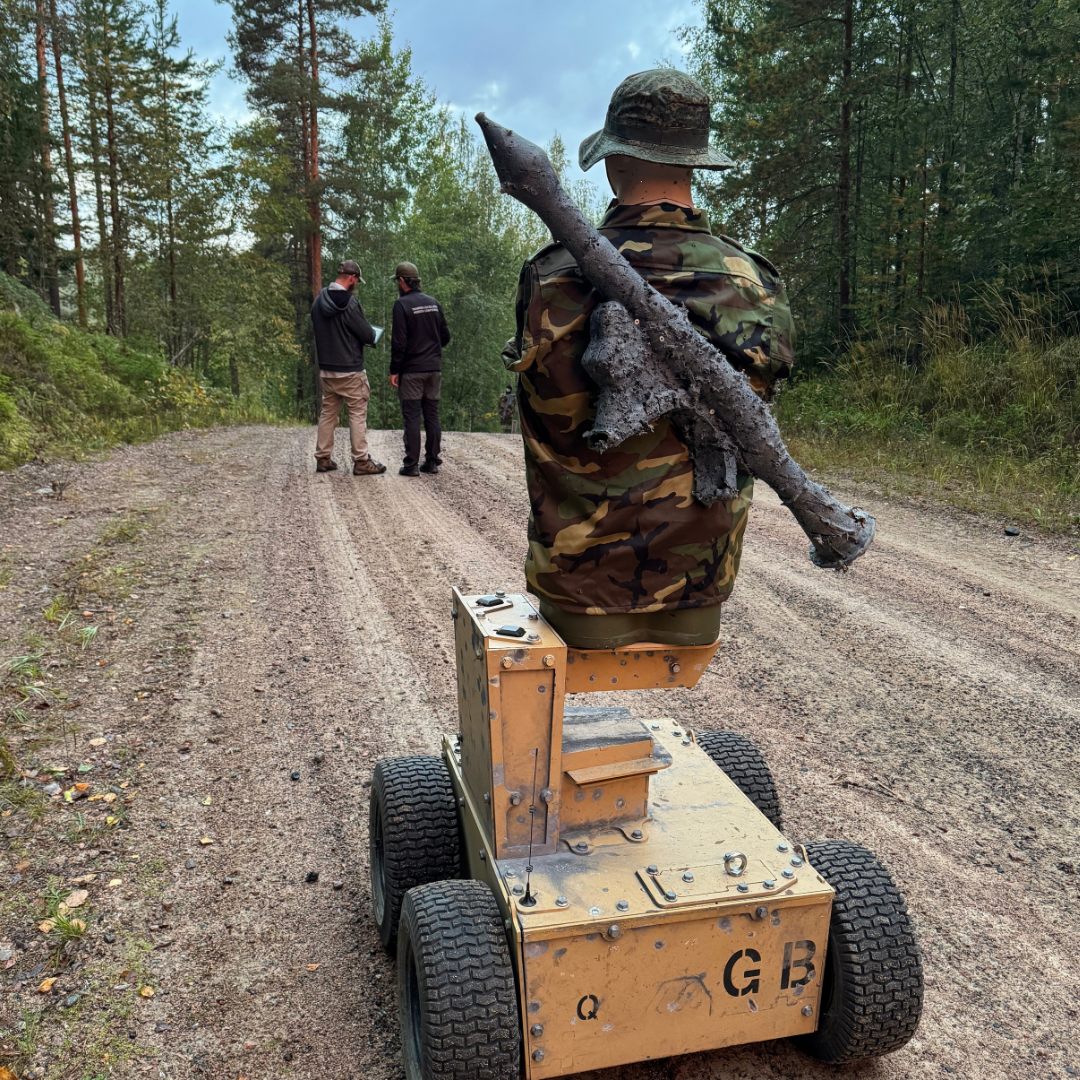
In this type of environment, autonomous robotic targets from Marathon Targets create a dynamic ground threat. The robots look, move and behave like people and vehicles, with active thermal signatures, muzzle flash and sound. When hit, they react by jerking, slowing down, stopping or falling. If one is engaged, the others can seek cover or counterattack.
The system includes infantry robots for outdoor and indoor ranges, the T100 vehicle robot and the ATAT towed target robot. Up to 50 targets can be controlled within the same exercise, and no fixed infrastructure is required – only a trailer for transport, storage and charging.
At the same time, Krattworks drone targets force the unit to deal with an airborne threat in the middle of everything else that is already happening.
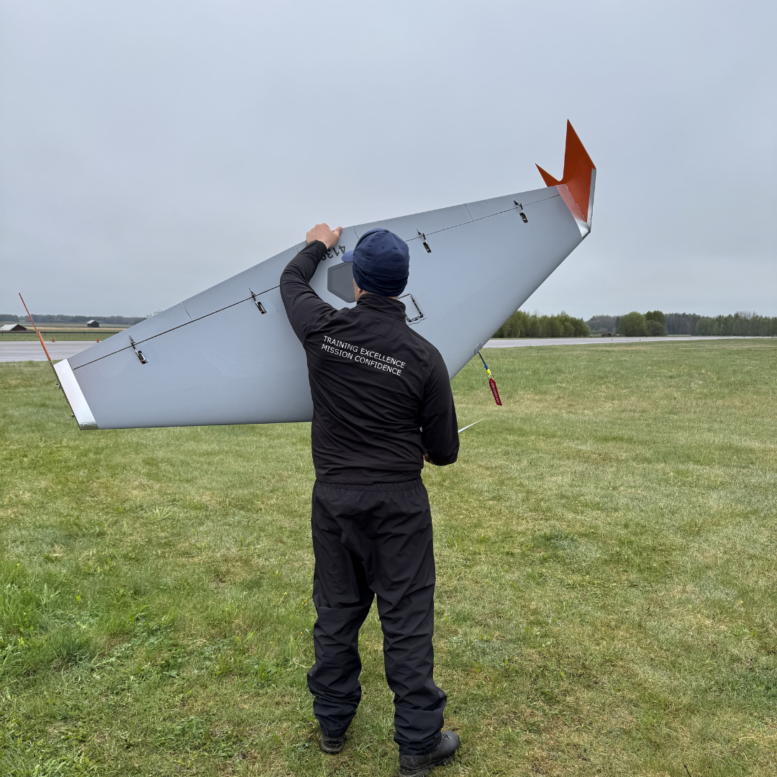
The Krattworks PARM quadcopter is used for C-UAS training with small arms, heavy machine guns and automatic cannons. Multiple drones can be flown simultaneously from the same ground station, and an EW version is available for training and testing electronic-warfare countermeasures.
For heavier air-defence systems, the DART fixed-wing target flies autonomously at approximately 200 km/h and at altitudes of up to 4,000 metres. It can be equipped with IR flares and radar reflectors for missile engagements.
For heavier weapon systems, including support weapons, ThermBright targets provide the visual and thermal signature of infantry and armoured vehicles. The targets are passive and require no power supply, cables or batteries. They are visible through NVG, IRV and fusion sights. ThermBright targets are comparatively low-cost, making it possible to expend them during live-fire training with service ammunition.
Mobility and scalability in a training environment
The support infrastructure behind a combat exercise should be designed to maximise efficiency once the scenario is paused. At that point, the environment should provide suitable conditions for briefings, replenishment and recovery.
Continest’s foldable CN20 container can be rapidly deployed in a rear area for pre- and post-exercise briefings. When unfolded, it provides approximately 14 m² of usable space, and two units can be connected to create a larger assembly room. The same solution can also be used for medical readiness, command functions or storage.
A container can be unfolded or folded in 5-10 minutes by one person and one machine operator. When folded, it is only 55 cm high, allowing ten units to be transported on a standard truck and trailer.
Rolatube’s rollable composite mast systems complement this by enabling lighting, cameras or radio-communication antennas to be raised quickly. A 3.5-metre antenna mast can be deployed in seconds, while a 7-metre mast can be erected by two people in approximately five minutes.
The result is a training environment that can be scaled to suit the requirement, from a smaller firing range to a training area with several concurrent activities.
“Ground targets, aerial targets, decoys, communications and infrastructure can each solve a task on their own. But the real value emerges when they are combined. Ground targets and drone targets in the air are a clear example. Individually, they create new opportunities, and together they can be used to build more complex scenarios.”
– Jonas Jonasson, CEO Obsima
The instructor
Every live-fire exercise depends on instructors with limited time. Every hour spent building scenarios, programming targets or troubleshooting technology is an hour taken away from training soldiers. Target equipment therefore needs to be quick to prepare and intuitive to use – even for personnel who do not work with the systems every day.
It starts with technology that does not require specialists. Marathon’s robotic targets are controlled through a common user interface, where scenarios can be saved and reused. The targets then operate autonomously and react to the unit’s fire. The instructor does not need to control every movement. Krattworks’ drone targets follow the same principle: all PARM drones and DART use the same software interface and fly their missions autonomously after launch.
Equally important is what is not required. ThermBright targets need no power supply, cables or batteries; they are simply positioned and ready for use. Continest containers and Rolatube masts can be deployed in minutes rather than hours and packed away just as quickly once the exercise is complete.
A shorter set-up time and faster reset mean more time for what actually matters: more repetitions, more scenarios and better after-action reviews. Time on the range should be spent training soldiers, not on preparation and post-exercise work.
The future of target equipment
The future of target equipment is less about individual products and more about what they make possible together. We therefore welcome a discussion focused on actual capability to deal with multiple types of threats and situations, rather than on isolated solutions.
This is where we stop talking about a ground target, an aerial target or a container as separate items. Target equipment becomes part of a training concept in which every component has a role in the scenario.
The products come from different technologies and suppliers, but they contribute to the same overall objective: a training environment that can be established quickly and scaled to meet the requirement.
As a distributor, Obsima AB will help bring that overall solution together based on the unit’s needs.
🔗 Marathon Targets
🔗 Continest Technologies Plc.
🔗 Krattworks
🔗 ThermBright Ltd.
🔗 Rolatube Technology
📰 RELATED NEWS: